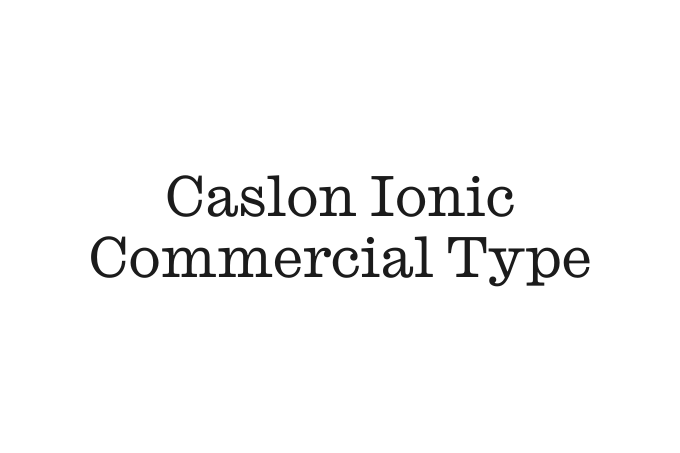
Bolder and more robust than the modern, yet lighter and more refined than the Egyptian, the Ionic with its bracketed serif was another innovation of the nineteenth century. Lesser known than Thorowgood's Clarendon, Caslon's Ionic No. 2 is a superb example of the form and greatly influenced the newspaper fonts of the next century. With additional weights and a matching Egyptian companion, Antique No. 6, it is a masterpiece of type designed to be robust and legible.
The Clarendon/Ionic is related to both the slab and the modern styles. It is an Egyptian with bracketed serifs and greater contrast or, on the other hand, a modern with reduced contrast adding strength to the serifs and thin strokes. In this way, the style offers an anonymity that is easy and pleasant to read, with a simple, timeless quality. This essential sturdiness still makes Ionics a popular choice for difficult print and screen conditions. In the nineteenth and twentieth centuries, they became the model for newspaper typefaces: economical, yet resistant to the deteriorations of rapid printing on poor quality paper.
Caslon's Ionic No. 2, which first appeared in the 1850s, is one of the finest examples of the form. The text sizes feature a generous x-height, compact ascenders and descenders, wide capitals, and a narrow lowercase with robust serifs — proportions ideal for newspaper typography where economy and clarity are at a premium. While never marketed explicitly as a newspaper face, the influence of Ionic No. 2 can be seen in the Linotype legibility series of the 1920s, not least in Chauncey H. Griffith's decision to initiate the series with Ionic No. 5.
For the revival, an accompanying secondary bold was drawn following Figgins' Antique No. 6, first introduced in the 1870s and one of the great survivors of the Victorian era. More characterful in appearance than Ionic No. 2, its proportions were gently altered so they share a cap- and x-height, creating a rich and versatile type family.