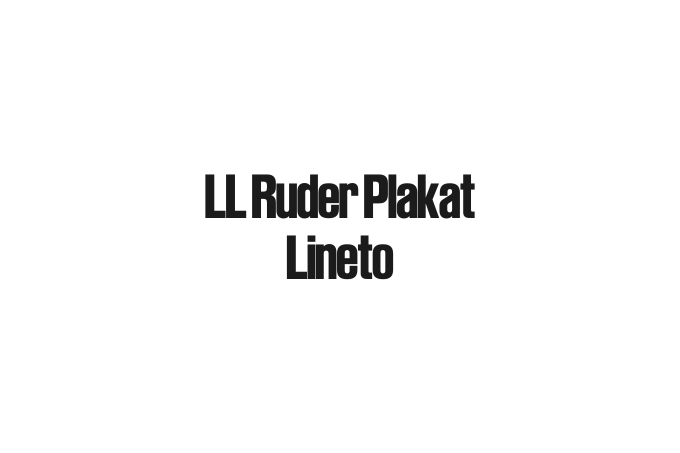
According to several sources, Emil Ruder’s poster font was developed with students at the Allgemeine Gewerbeschule Basel (AGS) in the early 1950s. Only towards the end of the decade, however, the new wood letters were ready for use on the school press. They were widely employed in a class that Ruder taught in 1961/62 and started to appear on posters designed by Ruder as well as by Armin Hofmann following 1962. Until the closing of the school’s printshop in 2001, the wooden Ruder-Schrift was primarily available to students.
Compared to an earlier condensed poster font that was available at the school’s printshop in the 1950s (and was widely used by students), the new design offered a broader range of sizes, from 6 to 48 Cicero (ca. 22 cm). It also included a number of subtle formal changes to letterforms, most notably in ‘a,’ ‘c,’ ‘s,’ ‘R,’ and others, which made the overall appearance of the typeface more straight and more graphic. Compared to all similar shapes that were frequently used on posters at the time, the formal rigor of Ruder’s letters is outstanding. Avoiding the slightest hint of any calligraphic strokes, Ruder’s letters are particularly clear and severe and are strictly aligned in almost every regard. Observed from today, they appear as if they were constructed in a grid using modular elements.
Knowing of the printshop’s impending closure, long-time typography teacher Hans-Christian Pulver proofed the full set of the 20 Cicero size (around 9 cm) for his personal archive. Almost fifteen years after retirement, at 77 years of age, he began reworking the typeface digitally. He made the shapes slightly more uniform, expanded the glyph set, and transferred some outstanding features of individual letters to others: the strong diagonal found in ‘S,’ ‘s,’ and ‘2’ was adapted to the ‘a,’ and the wide black junction of diagonal and stem in ‘K’ and ‘k’ was applied to ‘X’ and ‘x.’
At Lineto, Pulver’s drawings were re-worked, and the character set was expanded by Arve Båtevik, adhering to contemporary principles of type design that turned out to perfectly suit Ruder’s early attempts at grid-based design and modular letter shapes. It is no coincidence that the technologies of digital type allowed Ruder’s shapes to be infused with new life.