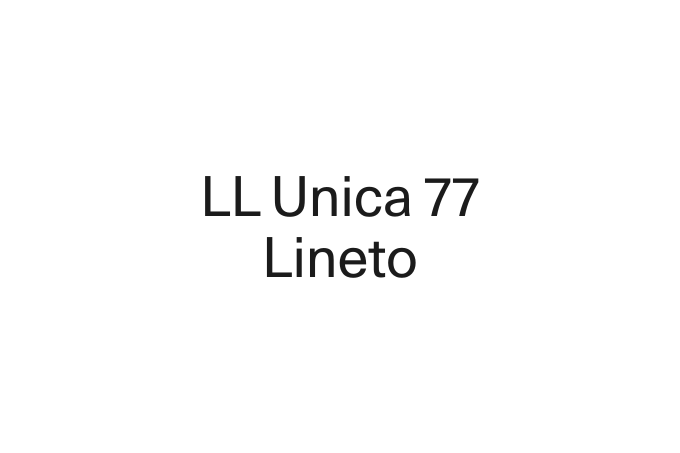
LL Unica77 is the only digital revival of Haas Unica (1980) authorised by the typeface’s original designers, Team’77. It was re-mastered by team member Christian Mengelt from their own drawings.
Unica has had a conflicted history from the very beginning. After Linotype bought a license for Neue Haas Grotesk (1957) and developed it into Helvetica for their hot-metal machines (1960) and for phototypesetting (1969), they prevented the Haas Type Foundry from licensing the font to any other manufacturer of phototypesetting devices. In response, Haas eventually decided to develop a new typeface tailor-made for the technology. They brought in Team’77 (André Gürtler, Christian Mengelt, Erich Gschwind) to conduct a thorough analysis of four formally related typefaces – Neue Haas Grotesk, Helvetica, Univers and Akzidenz Grotesk Buch – as a basis for the new design.
The achievement was significant. Haas Unica is often regarded as the pinnacle of modernist type design, arguably the most modern and the most Swiss typeface: one that embodies the idea of a ‘pure medium’, a ‘neutral carrier’. Upon its initial release with Bobst Graphic in 1981 (and later with Autologic and Linotype in 1984) Haas Unica seemed to deliver on what Helvetica promised.
Then, in a twist of fate, it disappeared. By the mid-1980s, phototypesetting’s days were numbered, and the personal computer had begun to radically alter the printing trade. In 1985, Linotype liquidated its subsidiary Stempel, which was the Haas foundry’s majority stakeholder, and when they finally terminated Haas four years later, Unica was buried with it.
But it was not forgotten. In 2004, Lineto co-founder Stephan Müller came across a PostScript version of Unica in a Scangraphic specimen book from the early 1990s. As the font was no longer available to buy, he sourced a black market copy, made minimal changes to it and discreetly used it for an artist book. This quasi-revival made waves, and before long, Haas Unica became a revered tool of choice for many of the designers associated with Lineto.
As there was still no legitimate version around by 2012, Lineto got in touch with Christian Mengelt. He informed us that the version Stephan had discovered wasn’t authorised by Team’77, who rejected it for its more monolinear drawing and the inconsistent spacing and kerning.
Mengelt maintained that Linotype had turned down Team’77s request for a digital re-issue of Haas Unica in 2010; he also discovered that they had given up the trademark already in 2005. We enthusiastically offered to collaborate for a full digital resurrection of Haas Unica, and Christian Mengelt dug out the original drawings, carefully reconstructing each of the eight original cuts. Maurice Göldner assisted in adapting characters and expanding the glyph sets.
The resulting LL Unica77 is rich with features and stylistic sets, offering a number of alternates and a full set of rounded punctuation and accents. A thorough re-working of the whole diacritics set was concluded in the fall of 2019.
At the same time, LL Unica77 was released for use in Cyrillic and Greek. Thanks to the fruitful collaboration between Irene Vlachou, Ilya Ruderman, Viktoriya Grabowska and Christian Mengelt, we are now able to further extend the journey of Haas Unica. Once consigned to the fate of phototypesetting (and Swiss modernism, one might add), LL Unica77 is now ready to finally come into its own in the digital age.
This includes a full condensed family (a project abandoned by Haas due to lack of funds around 1984), as well as a fully variable counterpart with three axes for weight, width and slant manipulation, all completed by Luca Pellegrini/Lineto in consultation with Christian Mengelt, and scheduled for release in late 2024.